
For Our Time Film | 2015-2025
Updated: Mar 4
10 Years of Wild Collaboration
It began with a dress.
In 2013, Centre for Sustainable Fashion researcher Prof Helen Storey was approached by the climate scientists at the UK MET Office and challenged to create a piece of work that could capture public imagination towards an informed understanding of climate change and all it means for our planet. The dress was first exhibited at a key moment in time, at the gateway to COP21 United Nations Climate Summit, Paris, in 2015.
The dress was created from a decommissioned UNHCR (United Nations High Commission for Refugees) refugee tent, that once housed a displaced Syrian family at Zaatari Camp in Jordan and was gifted to the project by UNHCR.
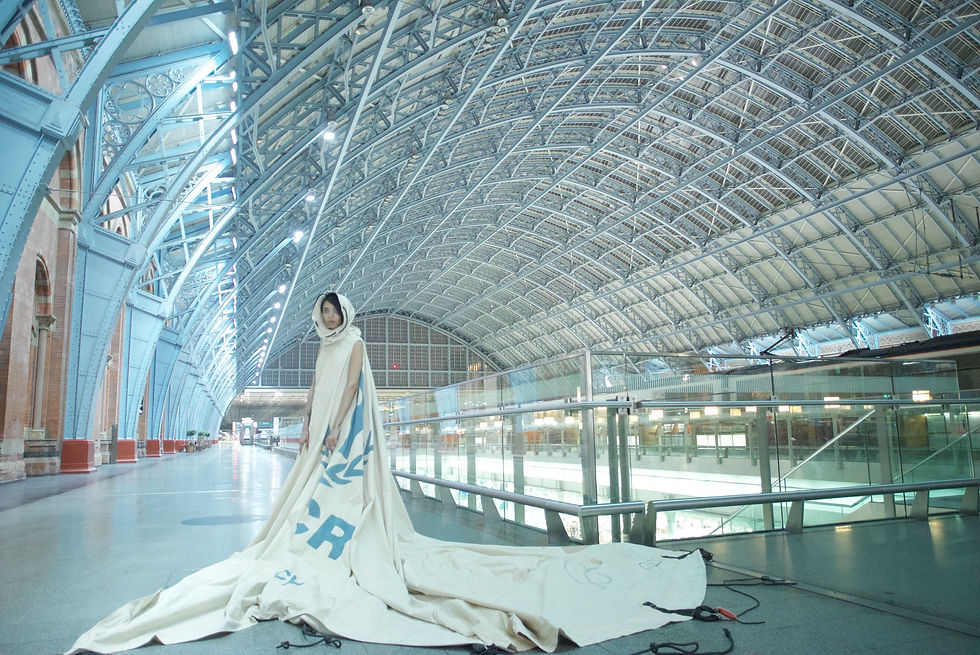
As the dress began to tour more widely, audience engagement sparked curiosity and interest in the lives this tent had sheltered before it became a dress. Notably, children questioned the work, asking: where are the family that lived in this tent now? Why did they have to leave their home? How can a whole family fit in the tent? What is life in the camp like for children my age?
It was these unresolved questions about the piece that, in 2016, took Helen to the gates of Zaatari to find answers – there, life changed entirely.
This film ‘For Our Time’, by David Betteridge, captures highlights of the 10-year journey from 2015-2025 that followed, in collaboration with Deepa Patel and a team which grew close to 300 people, across 3 continents. The work brought co-design to life with refugee communities in Africa (Malawi and Mozambique) and the Middle East (Jordan and Syria).
It is a story of wild collaboration and what can happen, at the edges of us all.
As a filmmaker, David shares his experiences from the past 10 years, and how he’s captured key moments that have catalysed change, into a 4-minute film:
“A filmmaker’s notes on how to not edit a film:
The story begins for me in 2015, with what I thought then was just an afternoon's work filming an art installation at St Pancras Station. Ten years later I’m looking back on a project that has spanned multiple short documentaries, countless pieces of art and media and extended into blockchain and AI. This film is an attempt to make sense of those ten years condensed into four minutes.
This is neither ‘my film’, nor a film that seeks to tell a story that is understandable to an audience who meet the project for the first time. It’s as much a question as an answer - a film that simply say’s ‘This Happened’, because attempts to explain fall short.
Over the ten years of working on the project I was never given a brief, just permission to be there, to document, to bring my own contribution, initially as an observer, and then a participant and contributor. This process changed the way that I make films and the way that I approach my life.
The film is both an offering to the 300 people involved over the years as a way to understand what we did and an archive for others to explore. It required an approach that is unauthorised, that removes the editor from the process, that offers no opinion. Constructed chronologically, of one second shots, framed with dates marking time, the filmmaker tries to hide their presence.
This is a story that needs to be known, not as an act of celebration that says ‘look what we did’ but rather a demonstration of a way of working, where imagination, human connection, and collaboration replace top-down process. Where humans are given the chance to create their own futures rather than fit into the processes of organisations.
To the 300 people who gave their love, energy and time to this I project, this is for you. Thank you. And to the audience who find this story for the first time I hope you find questions that bring you back. This is a beginning not an end.”
While the ‘For Our Time’ journey is multi-faceted and unconfined in impact, it includes three distinct projects; Dress for Our Time, Zaatari Action and Vital Signs. Several key partners from the Zaatari Action project strive to express the profound changes that have transpired across this decade and through various collaborations, timebound and moving within boundaries but boundless in reach and boundaryless in mindset.
The ‘Made in Zataari’ Centre was an initiative that grew into a fully trained, commercialised organisation created to uplift women through economic independence, autonomy and confidence. Located in Zataari Refugee Camp, on the Jordan/Syria border, it enabled women to professionalise skills, such as embroidery, jewellery design, perfume, and soap production, selling their high-quality products.
Working in collaboration with Givaudan, one of the world’s largest creators of fragrance, and local partners, it established a recognised brand while creating sustainable livelihoods for all involved. Givaudan provided training and materials, fostering a self-sufficient locally led centre which advocated for women in every sense.
Anne Louvet, Global Business Director at Unilever Beauty & Wellbeing, shares the journey from idea to fruition, illuminating the impact the ‘Made in Zaatari’ Givaudan partnership had in transforming lives:
“The Made in Zaatari project would not have existed without the quiet, visionary leadership of Prof Helen Storey. Helen has a rare combination of skills - out of the box creative thinking, a hands-on approach and the ability to bring unlikely groups of experts together to bring the vision to life - always listening attentively and building upon the needs, desires and existing skills of the communities with whom she works.
It certainly required a bold creative vision to imagine a fragrance training for women displaced by the war in Syria and living in the largest refugee camp in Jordan. And yet this is the idea which grew from Givaudan's first meeting with Prof Helen Storey in 2017 and based upon Helen's discussions with female community leaders during her first visit to the camp.
Just a few weeks later, with funding from The Givaudan Foundation, a group of Givaudan fragrance experts, who had volunteered to support the initiative, met 20 highly motivated ladies in a UNHCR community centre within a dusty compound in Zaatari camp. Then something magical happened. With fragrance as the vector, strong human connections were made, existing skills and learning potential were revealed, hopes and dreams were evoked.
The women's dream - to produce and sell hand-crafted fragranced soaps - became the basis for a unique long-term Livelihoods project which has since been replicated in other refugee communities and included the creation of the Made in Zaatari center, a community space for women which included a soap and perfume lab, community kitchen, creche and a shop.
Involvement in the Made in Zaatari project was a life-changing experience for everyone involved. Helen has been our mentor, our trusted companion and our sounding post throughout the different stages of the project, as the ladies progressed through training and professionalisation and appropriate external community partners became involved.
The power of fragrance as an educational tool was also leveraged through numerous events involving children and teenagers in Zaatari camp. These events were an opportunity to involve the women directly, fostering knowledge sharing and inter-generational exchange.”
With the fall of the Assad regime at the end of 2024, there was, for the first time in 14 years, a possibility for a return home to Syria. Some of the women from the ‘Made in Zaatari’ centre have returned to Syria since, taking with them all the skills and training they experienced during their years together with Givaudan too. With the news of the US election and President Trump’s subsequent closure of USAID there was an overnight impact on the whole humanitarian sector and along with significant change and collapse in many places, it was with great sadness, that the ‘Made in Zaatari’ centre was closed in April 2025.
Irene Omondi, currently heading up the UNHCR operation in Nigeria and former UNHCR Head of Zaatari Refugee Camp Jordan, describes the decade-long, deeply human collaboration grounded in care, creativity, and shared transformation. She highlights the power of skill-sharing not merely as vocational training, but as a form of knowledge that can heal and can restore human wholeness:
“Working with Prof. Helen Storey and Deepa Patel over 10 years in Zaatari refugee camp – Jordan and Maratane settlement in Mozambique has been a journey of transformation. ‘Made in Zaatari’, was a concept that came to light through a devotion for co-creation, together with all the women makers in the camp. I recall the nice fragrant smell of perfume made by one of the women who called it ‘wishes’, as the scent she had made, reminded her of home. These smiles, in women both far and wide and the transformation of the young TIGER girls warms my heart.
It’s really all about passing on skills and capabilities, but crucially, sharing knowledge that can heal, and that puts human wholeness at its centre. As UNHCR Designer in residence, Prof Helen has dedicated years of working and commitment to bettering refugee lives, as a part of a wider collaborative family”.
Rehab Khalifa, formerly of UNCHR Jordan, reflects on a deep sense of kinship formed between women through shared experiences, learning, and collective effort -relationships built in defiance of enormous odds:
“It was more than a project, it was a movement of resilience, creativity, and hope. I’m deeply proud to have led this initiative from UNHCR side, which empowered women to transform their skills into livelihoods and dignity. Seeing many of those women now leading independent lives and businesses is a testament to what social protection can achieve when it’s given the space and support it deserves.
It’s heartbreaking that in these difficult times, social protection is being sidelined, and that the centre, once a beacon of possibility, has quietly closed. But its impact lives on in every woman who carries her skills, her perfume called “wishes,” and her memories of home into the future.
To all my colleagues and partners who supported this journey to Helen Storey, Deepa Patel, Irene Omondi, David Betteridge, London College of Fashion, University of the Arts London.
Let’s continue to advocate for spaces where healing, knowledge sharing, and human wholeness are at the heart of humanitarian work.
Made in Zaatari may have closed its doors, now but its spirit endures.”
Beyond Collapse
In Africa, we move at the speed of refugee survival, remaining connected to the community leaders whose roles are now supercharged, as they try to contend with an unprecedented loss of protection and basic life resources.
With the closure of UNHCR field offices in Malawi and Mozambique, Helen, Deepa and David are responding personally to strategic and practical requests for help. Examples include funding assessments to identify where the most vulnerable in camp are living, identifying mechanisms for water distribution and paying for coffins.
Whilst a fashion mentoring project continues, whereby academics from local Luanar University, Malawi, gift their expertise to designers in camp and here at London College of Fashion, we are co designing a new project between our students, Dzaleka Arts Lab, UNHCR MADE51 and a local SME, who can provide employment and food for a limited number of women. In Mozambique, the soap makers are still in the process of certifying their products, and whilst the original vision, of reducing refugee dependency on UNHCR by making them their nominated industrial suppliers is no longer possible, it opens other commercial possibilities.
There will be a life beyond collapse, and we are using all we have learnt in the last 10 years to slowly and carefully reimagine what can be possible, together.


Comments