
Next Gen Reflections: If the Cost of Fashion is Community, the Price is Too High
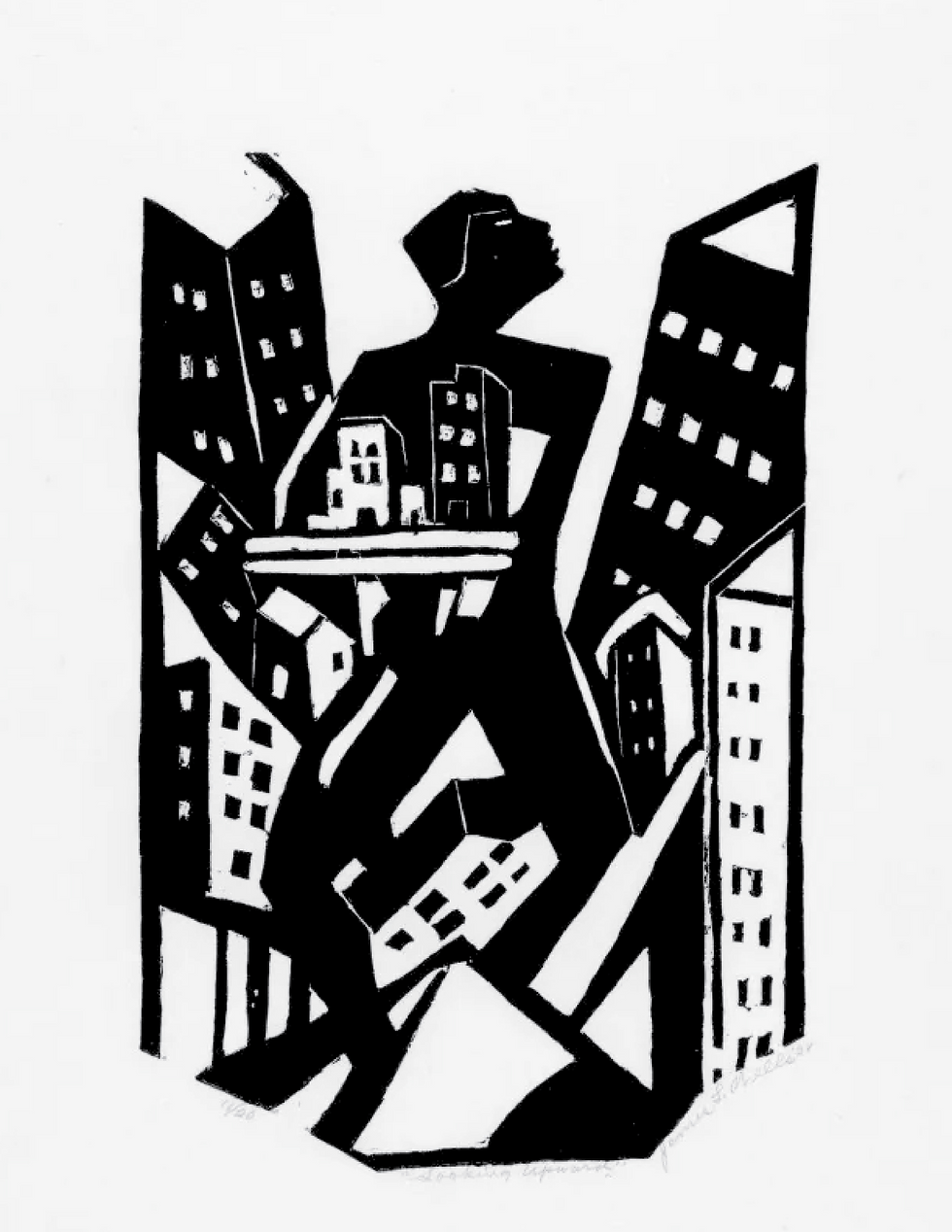
Next Gen Reflections is a series of articles written by members of Next Gen Assembly, an impactful advocacy programme for talented students and early-career professionals, led by Global Fashion Agenda and Centre for Sustainable Fashion’s Fashion Values programme, supported by Target. This article was written by 2025 member Mel Corchado.
Warm maroon lighting washed over tufted leather couches like a filter you couldn’t turn off. Waiters floated by with sponsored cocktails. There was a certain understanding that every name on the guest list meant something - editors, influencers, designers, people who decide what gets seen and what disappears. On paper, it was the room you’re supposed to want. The kind Fashion tells you is proof you’re in. You’ve arrived.
And yet, standing there with a drink in my hand, I felt it immediately: the air was thin. The conversations were rehearsed. The glamour was loud, but the room felt empty. Cold.
People did not know each other. Or if they did, it was the kind of knowing that lives on Instagram. A quick “Let’s get a picture…” type of intimacy. Positioning in place of presence. I felt a strange pressure, though maybe self-inflicted, to not ask too many questions, as if connection itself carried too much risk in a room built on optics.
A party is supposed to be the simplest form of community. So if even that feels hollow, something deeper is at play.
When I say Fashion, with a capital F, I mean the institutions that manufacture global fashion moments. The conglomerates. The fashion weeks. The schools. The supply chains. Capital F Fashion orbits wealth and power. Scarcity and exclusivity are framed as inevitabilities rather than choices. Competition is introduced early and rewarded often. But scarce civilizations war. They do not thrive.
Fashion’s dominant logic mirrors broader economic systems that disconnect people from materials, from makers, from meaning. Globalised supply chains obscure the hands that sew. Creative directors are pushed to deliver collections at a pace that leaves little room for reflection. Teams operate in silos, far from production realities. Speed becomes a virtue, and volume, proof of relevance.
Let’s be honest. When a designer is responsible for nearly eighteen collections a year, as in the case of Jonathan Anderson, can depth survive that cadence? This is not a question of talent. It is a question of structure. Fatigue and disconnection are built into the system. Even couture can begin to feel optimized for visibility rather than impact. And when production is optimized for visibility, relationships become secondary. The same distance I felt at that party - proximity without connection - exists through the system itself.
We know community matters. As they say, if you want to go fast, go alone. If you want to go far, go together.
In Bowling Alone, Robert Putnam describes social capital as the networks of trust and reciprocity that allow societies to function (Putnam, 2000). The Roseto study offers a striking example. In the mid-20th century, researchers found that residents of Roseto, Pennsylvania had unusually low rates of heart disease despite diets rich in fat and high smoking rates. The protective factor was not medical. It was social. Multigenerational households. Dense community ties. Mutual support. When those bonds weakened over time, heart disease rates rose (Egolf et.al., 1992).
Community can shape life expectancy. But when social capital erodes, institutions weaken and Fashion is no exception.
The most influential creative movements were collective. The Antwerp Six sharpened their thinking against one another. The Harlem Renaissance was a network, not a solo act. Loewe began as a leather-working collective in Madrid before it became a global house. Even your favorite collection by [insert your favorite designer here] was likely built by a team in the dozens. Shared risk produces vision. Good clothes come from relationships.
And long before Fashion capitalized itself, communities around the world were practicing relational design. Consider Andean weaving, practiced by Indigenous communities across the Andes and dating back to around 3000 BCE. Women wove – and continue to weave – with alpaca and llama fibers raised within ecological limits; their patterns encoding lineage, region, spirituality, and relationship to land. Historically, the system was regenerative: land was not exhausted, makers were not separated from materials, production was scaled to community needs, and knowledge moved intergenerationally, not extractively. Creative excellence emerged, and continues to endure, because of slowness, not in spite of it.
Sustainability and innovation are not only material; they are relational. Luxury depends on continuity. Seamstresses who understand a designer’s instincts without instruction. Patternmakers who refine a silhouette across seasons. Factory partners who are treated as collaborators rather than expendable labor. Craft economies thrive when knowledge and resources are shared and preserved.
Garments absorb the speed and disconnection of the systems that produce them. Rushed production reveals itself in fit, in fabric choice, in longevity. You cannot rush respect. You cannot outsource care. You cannot manufacture community.
True community, the kind that creates movements not just moments, requires us to slow down and accept the speed of relationships.
What would that acceptance look like?
It would mean treating prototyping as conversation. Building through iteration and mutual evolution. Choosing partners based on shared values, not just budgets or visibility. Allowing time for trust to develop while remaining open to risk in pursuit of something meaningful. Measuring success not only in margins or impressions, but in continuity.
It would also mean something far simpler.
It would mean putting our phones down at a party and looking around the room – beyond the followers, metrics, and optics. Making eye contact. And having the courage not only to ask questions, but to listen to the answers.
Because that fashion week party was not an anomaly. It was a mirror. A room full of people gathered under the banner of creativity who struggled to connect.
If the cost of Fashion is community, the price is too high.
About Mel, Next Gen Assembly 2025 member
Mel Corchado is a Brooklyn-based Boricua fashion designer exploring how fashion can challenge dominant narratives and shift consciousness in service of decolonization. Her research-driven practice builds alternatives to the fashion industrial complex through participatory methods like upcycling, skill-sharing, and relationship-building. Rooted in collaboration, care, and transformation, Corchado uses fashion as a vehicle for political education and social connection. She debuted her graduate thesis, Everything for Everybody, during NYFW SS24 at the Brooklyn Museum. A Parsons MFA Fashion Design and Society alumna, CFDA scholar, Teen Vogue Generation Next Designer, and Open Call 2025 Artist at The Shed, Corchado continues to shape fashion’s future from the inside out.
Artwork Citations:
Image 1: Looking Upward by James Lesesne Wells, 1928
Image 2: Photo of the Young Lords by David Fenton, 1971
Image 3: Photo of the Antwerp Six by Karel Fonteyne, 1986
Image 4: Mantle (detail), Paracas, Peru, 100 BC/AD 200
References:
Egolf, B., Lasker, J., Wolf, S. and Potvin, L. (1992), 'The Roseto effect: a 50-year comparison of mortality rates', American Journal of Public Health, 82(8), pp. 1079-1176. Available at: https://doi.org/10.2105/AJPH.82.8.1089
Putnam, R.D. (2000) Bowling Alone: The Collapse and Revival of American Community. Simon & Schuster.


Comments